The machine that only moves when your dog decides to move
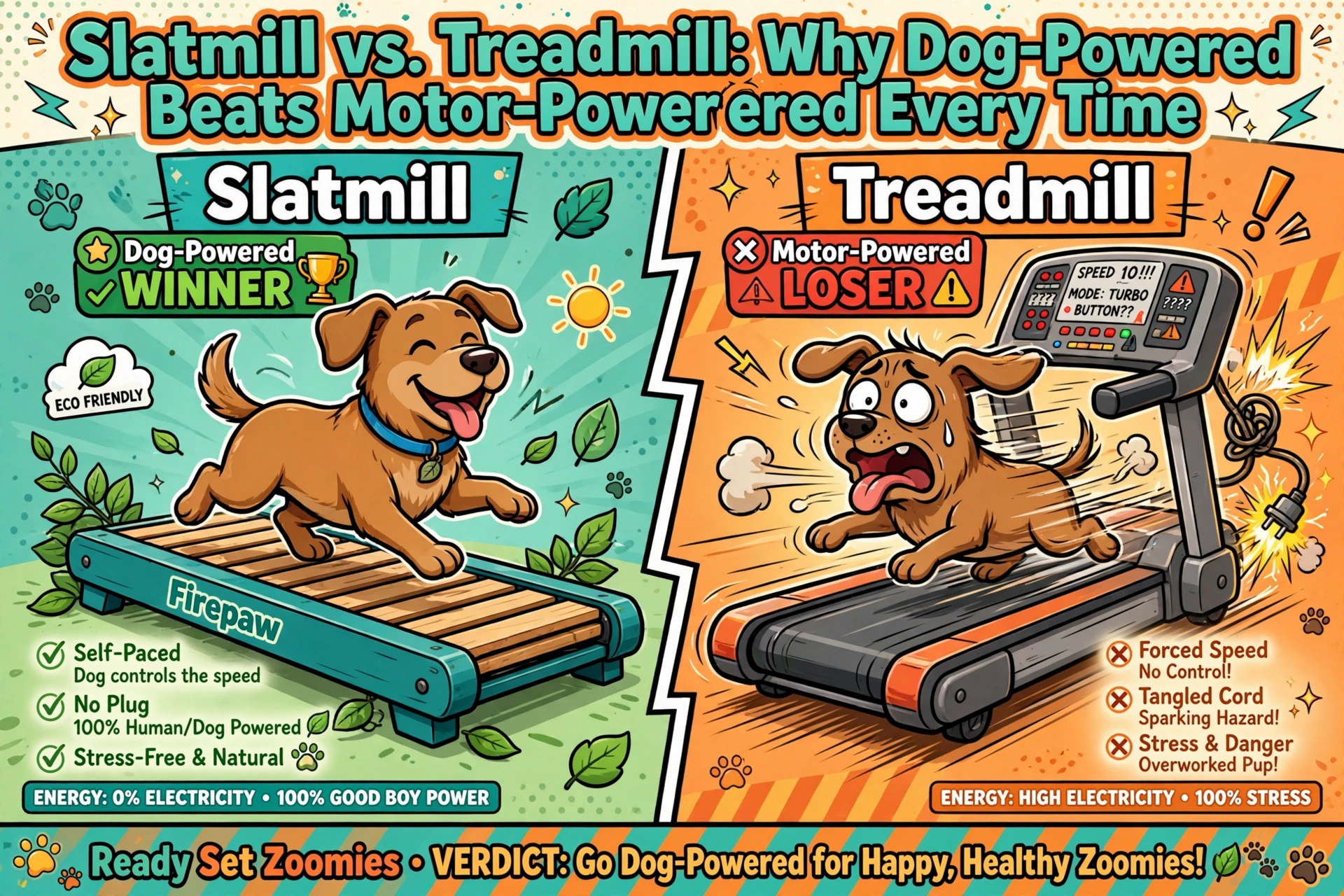
Walk into most gyms and you’ll see a treadmill: a motor, a belt, a speed you have to keep up with. A slatmill is the opposite idea. It’s a series of interlocking slats mounted on low-friction rollers, and it has no motor at all. The belt moves because your dog pushes it. Stop pushing, and it stops. That single design choice changes almost everything about how the exercise feels and what it does for the body (Slatmills.com).
1. Your dog controls the pace, which means your dog controls the risk
On a motorized treadmill, the machine sets a speed and the dog has to match it. If the dog gets tired, distracted, or slightly out of rhythm, the belt keeps dragging them forward. On a slatmill, effort and speed are the same thing. Dogs surge when they feel strong and coast when they need a breather, which produces a far more natural running rhythm and dramatically lowers the chance of a stumble turning into an injury (Superior Strides).
2. It’s cardio without the pounding
Think of it as a StairMaster for dogs: controlled, repetitive, low-impact, and brutally effective at building cardiovascular endurance and hind-end muscle (Dootyful Scoopers). Because the motion is restricted to straight-line forward travel, there’s none of the twisting, cutting, and hard landing you get from fetch on grass or a game of chase at the dog park. Less rotational load through the joints means older dogs and recovering dogs can build strength at a pace their body tolerates (K9 Kardio).
3. It’s a thinking exercise, not just a physical one
This is the part owners don’t expect. Learning to load onto the belt, find a rhythm, and self-regulate speed is a coordination and problem-solving task. Structured slatmill work is used to support proprioception, body awareness, and confidence — not just muscle (Firepaw). Dogs come off the belt tired in the way a good workout makes you tired: settled, satisfied, and mentally quiet.
4. It’s the reason working-dog programs use them
Police, protection, detection, and sport dogs need conditioning that’s repeatable and measurable — the same distance, the same effort, the same session, week after week, regardless of weather or terrain. Slatmills give handlers exactly that kind of controlled cardiovascular base, which is why they’ve become standard equipment in serious working-dog programs (Chase Pro).
5. No weather, no leash reactivity, no distractions
Rain, heat index, icy sidewalks, a reactive neighbor’s dog, a construction crew on your block — none of it matters. A treadmill session removes environmental variables entirely, which is one of the most commonly cited reasons vets recommend indoor treadmill work in the first place (Preventive Vet). For dogs that struggle on walks because of other dogs, traffic, or noise, this is exercise without the trigger.
The honest caveat
A slatmill is not a replacement for sniffing, exploring, and social time — those needs are real and different. And it’s not a “set it and forget it” tool. Dogs should be introduced gradually, with a proper warm-up and cool-down, under supervision, by someone who can read fatigue before the dog hits it. That’s the whole reason a supervised session exists instead of a machine in your garage.
CTA: Curious how your dog would take to a belt they control? We bring the gym to your driveway. [Book a first session →]